
Fast answer
What does nursing home survey readiness need to prove?
Survey readiness has to show a current emergency-preparedness file, an all-hazards risk assessment, training and testing evidence, and a record of real events that approached the facility. In an OIG audit, 150 of 154 nursing homes reviewed had emergency-preparedness problems, which is exactly why stale binders create risk.
The binder is annual, but exposure is not. A wildfire smoke day, outage watch, or flood advisory can matter months before anyone asks for the documentation. Exposure Watch keeps that trail from going missing.
Why survey week becomes a scramble
Survey pressure is often documentation pressure. The administrator remembers the storm, the DON remembers the staffing calls, and the binder remembers none of it unless someone saved the evidence while it was fresh.
That is the gap this page is built around: a reviewable record for what happened near each building, without asking the team to reconstruct the year from inbox searches.
Survey-readiness record checklist
Use this as a working file review before survey week, not as a substitute for your official program.
| Element | How to use it |
|---|---|
| Facility scope | Confirm which buildings are in the review, and which are not. |
| Annual review evidence | Gather last review date, owner, updates, and unresolved gaps. |
| External-hazard history | Preserve what approached each facility, when it was first seen, and when it was checked. |
Download worksheet This static worksheet is a practical review aid, not a certification or official filing tool.
How Exposure Watch helps
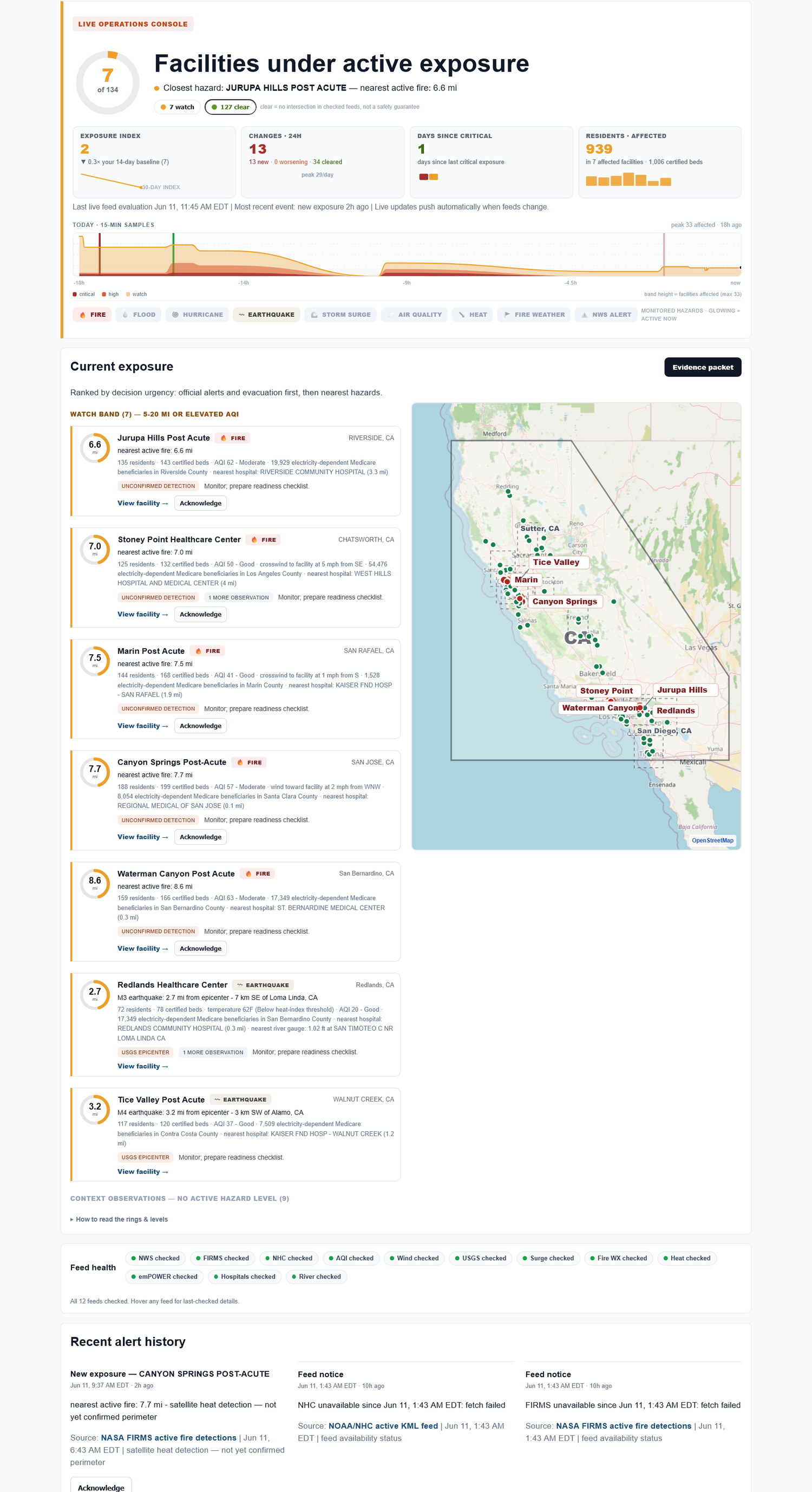
Exposure Watch watches external hazards around monitored buildings and saves each exposure with the facility, source, status, first-seen time, last-checked time, and change history. Your team gets a live view for today and a record for survey preparation, annual review, after-action files, board questions, and insurance conversations.
The evidence trail to keep on every page
| Facility | Hazard | Source | Status / distance | First seen | Last checked | Export |
|---|---|---|---|---|---|---|
| Facility A | Wildfire smoke | Authoritative, source-cited alert | Nearby / active | timestamp | timestamp | Export |
| Facility B | Power shutoff | Authoritative, source-cited notice | Possible impact | timestamp | timestamp | Export |
| Facility C | Flood | Authoritative, source-cited alert | Watch area | timestamp | timestamp | Export |
Built automatically from the same live checks - no extra binder work.
What Exposure Watch does not do
Exposure Watch does not replace your emergency-preparedness program, make compliance guarantees, file regulatory reports, run incident command, or tell staff what to do in the moment. It helps your team keep the facility-level external-hazard picture and evidence trail current.
FAQ
What should a survey-ready exposure file include?
At minimum, it should show which facility was in scope, what hazard approached or affected it, the source behind the finding, when it was first seen, and when it was last checked. Your emergency-preparedness owner decides how that record fits the official file.
Why does survey readiness need evidence between annual reviews?
Because actual exposure does not wait for the annual binder update. A saved trail gives the team something concrete to review when the event is weeks or months old.
Does Exposure Watch collect PHI?
No. Exposure Watch is facility-level external-hazard monitoring. Do not enter resident names, patient records, medical details, or clinical data.
Does Exposure Watch tell staff what to do during an incident?
No. It surfaces facility exposure and preserves the record. Your team keeps responsibility for operations, clinical judgment, reporting, and emergency-preparedness decisions.