
Fast answer
What should nursing home emergency-preparedness documentation include?
Survey-ready emergency-preparedness documentation should connect plans, training, testing, actual events, and annual review evidence. The weak spot is usually not whether a policy exists; it is whether the team can show what changed, what was checked, and what the facility knew at the time.
A clean binder can still have a blind spot. If the exposure record lives in screenshots and memory, the file is brittle when surveyors or regional leaders ask follow-up questions.
Why documentation gets thin at the exact wrong moment
After a quiet month, nobody wants to spend time preserving a non-event. After a bad month, nobody has time to do archaeology. That is how source records scatter.
The better habit is to let the exposure record accumulate while checks are already happening, then use it as review material when the formal documentation work begins.
Survey-ready documentation worksheet
Use this short worksheet to capture what the team needs before the formal review, not as a substitute for the official program.
| Element | How to use it |
|---|---|
| Current plan file | Confirm the plan, policies, training, testing, and annual review evidence are easy to find. |
| Event history | Attach source-cited hazard rows instead of relying on memory. |
| Open gaps | List what needs owner follow-up before survey week. |
Download worksheet This static worksheet is a practical review aid, not a certification or official filing tool.
How Exposure Watch helps
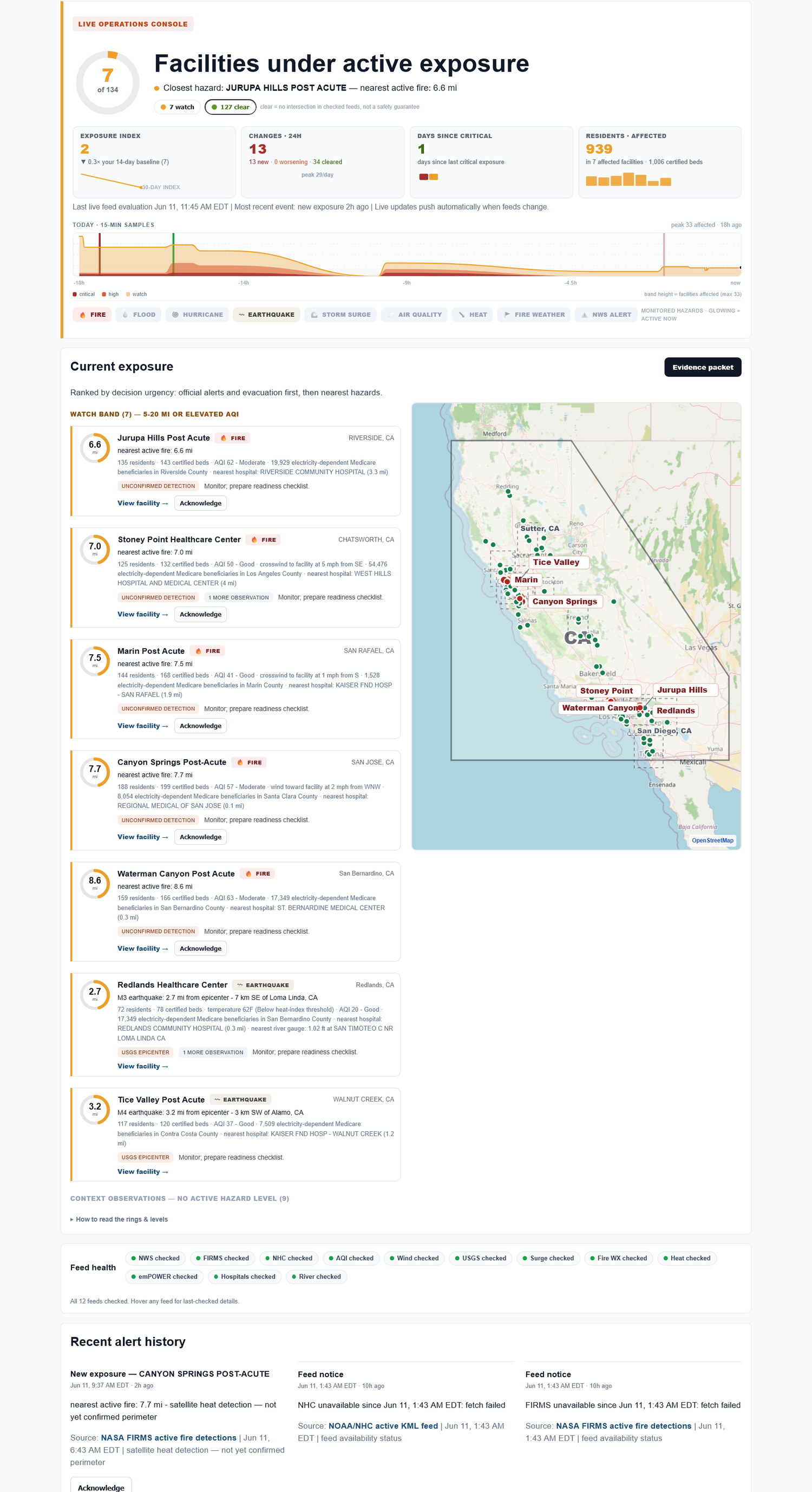
Exposure Watch keeps a facility-level record of external hazards around each monitored building, including source, status, timing, and change history. It is not the emergency-preparedness program; it is a reviewable evidence layer your program can use.
The evidence trail to keep on every page
| Facility | Hazard | Source | Status / distance | First seen | Last checked | Export |
|---|---|---|---|---|---|---|
| Facility A | Wildfire smoke | Authoritative, source-cited alert | Nearby / active | timestamp | timestamp | Export |
| Facility B | Power shutoff | Authoritative, source-cited notice | Possible impact | timestamp | timestamp | Export |
| Facility C | Flood | Authoritative, source-cited alert | Watch area | timestamp | timestamp | Export |
Built automatically from the same live checks - no extra binder work.
What Exposure Watch does not do
Exposure Watch does not replace your emergency-preparedness program, make compliance guarantees, file regulatory reports, run incident command, or tell staff what to do in the moment. It helps your team keep the facility-level external-hazard picture and evidence trail current.
FAQ
What makes emergency-preparedness documentation survey-ready?
It should be current, tied to facility and community risks, and supported by documentation for training, testing, actual events, and review. Exposure Watch contributes source-cited external-hazard history, not policies or official filings.
Can this replace the facility emergency plan?
No. It supports documentation by preserving external-hazard history. The plan, policies, procedures, training, and testing remain your facility work.
Does Exposure Watch collect PHI?
No. Exposure Watch is facility-level external-hazard monitoring. Do not enter resident names, patient records, medical details, or clinical data.
Does Exposure Watch tell staff what to do during an incident?
No. It surfaces facility exposure and preserves the record. Your team keeps responsibility for operations, clinical judgment, reporting, and emergency-preparedness decisions.