
Fast answer
Why does survey pressure land on the DON?
DONs often get pulled into emergency-preparedness questions because they can explain resident impact, staffing realities, and what the facility actually did. The problem is that the external-hazard trail may not live with them until someone asks for it.
The issue is rarely that nobody cared. It is that busy teams remember the event but not the exact source, timestamp, distance, or status from three months ago.
Why survey pressure concentrates on one person
When documentation is fragmented, the person who can explain the building becomes the person expected to reconstruct the whole timeline.
A shared exposure trail gives the administrator, DON, regional nurse, and compliance lead a common record before the question turns personal.
DON survey-week record checklist
Use this short worksheet to capture what the team needs before the formal review, not as a substitute for the official program.
| Element | How to use it |
|---|---|
| Shared record | Put the source timeline somewhere leadership can review before asking the DON to reconstruct it. |
| Clinical boundary | Keep PHI and resident details out of the external-hazard evidence trail. |
| Follow-up owner | Name who will answer documentation questions after the survey huddle. |
Download worksheet This static worksheet is a practical review aid, not a certification or official filing tool.
How Exposure Watch helps
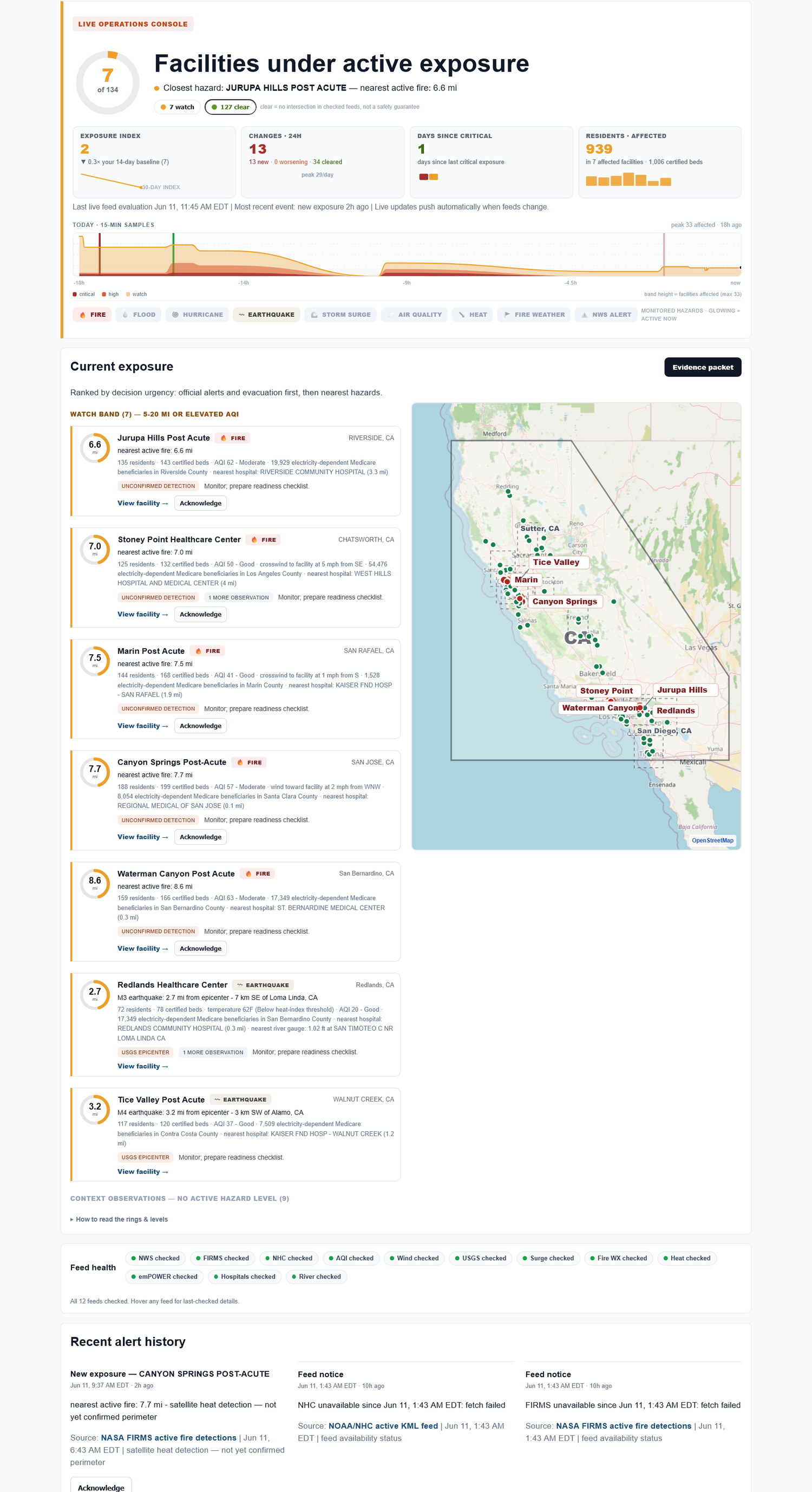
Exposure Watch keeps facility-level external-hazard history in one place. It helps the leadership team review what was seen and when, without turning the DON into the only archive.
The evidence trail to keep on every page
| Facility | Hazard | Source | Status / distance | First seen | Last checked | Export |
|---|---|---|---|---|---|---|
| Facility A | Wildfire smoke | Authoritative, source-cited alert | Nearby / active | timestamp | timestamp | Export |
| Facility B | Power shutoff | Authoritative, source-cited notice | Possible impact | timestamp | timestamp | Export |
| Facility C | Flood | Authoritative, source-cited alert | Watch area | timestamp | timestamp | Export |
Built automatically from the same live checks - no extra binder work.
What Exposure Watch does not do
Exposure Watch does not replace your emergency-preparedness program, make compliance guarantees, file regulatory reports, run incident command, or tell staff what to do in the moment. It helps your team keep the facility-level external-hazard picture and evidence trail current.
FAQ
Why does emergency-preparedness documentation often fall on the DON?
The DON often knows the resident-care implications and shift realities, so survey questions can drift there when the shared documentation is incomplete.
How can operators reduce survey-week pressure on clinical leaders?
Give the whole team a shared record of exposure, timing, and sources before survey week. That does not replace clinical judgment, but it reduces reconstruction work.
Does Exposure Watch collect PHI?
No. Exposure Watch is facility-level external-hazard monitoring. Do not enter resident names, patient records, medical details, or clinical data.
Does Exposure Watch tell staff what to do during an incident?
No. It surfaces facility exposure and preserves the record. Your team keeps responsibility for operations, clinical judgment, reporting, and emergency-preparedness decisions.