
Fast answer
What makes California SNF disaster readiness different?
California SNFs face emergency-preparedness expectations under federal rules and state-specific pressure around PSPS, backup power, drills, and wildfire exposure. The January 2025 Los Angeles fires reportedly forced large care-facility evacuations and destroyed two SNFs, which is the kind of event history operators cannot afford to reconstruct from memory.
Do not market a magic deadline. The safer California story is the ongoing regime: PSPS reporting, 96-hour backup-power requirements, and repeated wildfire or outage exposure around real buildings.
Why California disaster evidence is different
California operators have to think about federal survey expectations and state-specific power and wildfire pressure at the same time. A statewide headline does not tell you which building is in the path.
That is why the useful record is facility-level: what was near this building, when it was checked, and what source supported the view.
California SNF disaster evidence worksheet
Use this short worksheet to capture what the team needs before the formal review, not as a substitute for the official program.
| Element | How to use it |
|---|---|
| State-specific context | Separate PSPS, backup-power, drill, and wildfire evidence so the review stays clear. |
| Facility-level record | Avoid statewide summaries when a building-level source row is available. |
| Deadline check | Verify current state guidance before relying on any date summary. |
Download worksheet This static worksheet is a practical review aid, not a certification or official filing tool.
How Exposure Watch helps
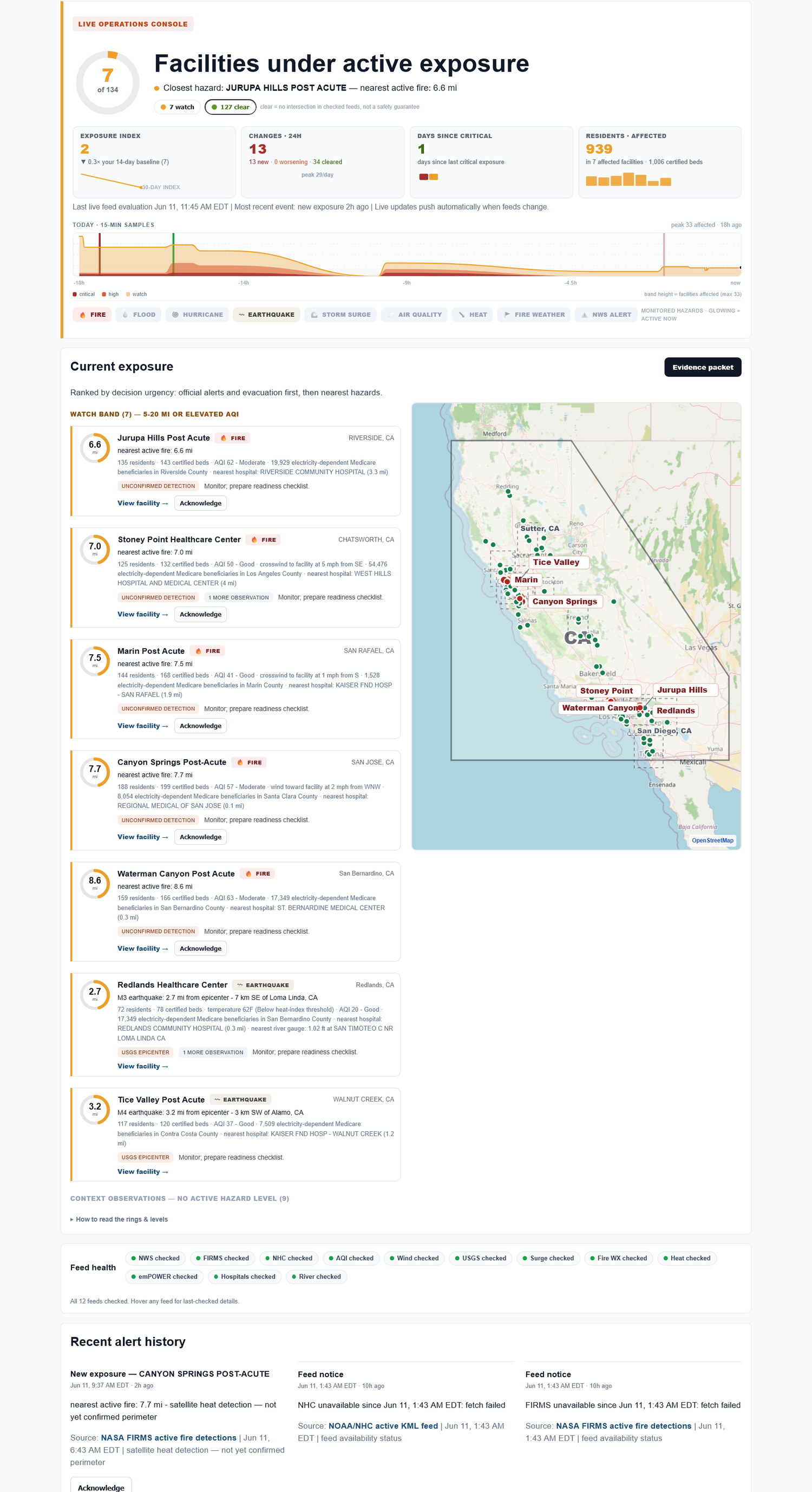
Exposure Watch preserves California facility exposure rows with source, status, timing, and change history. It supports review of the year your buildings actually experienced without pretending to make regulatory decisions for you.
The evidence trail to keep on every page
| Facility | Hazard | Source | Status / distance | First seen | Last checked | Export |
|---|---|---|---|---|---|---|
| Facility A | Wildfire smoke | Authoritative, source-cited alert | Nearby / active | timestamp | timestamp | Export |
| Facility B | Power shutoff | Authoritative, source-cited notice | Possible impact | timestamp | timestamp | Export |
| Facility C | Flood | Authoritative, source-cited alert | Watch area | timestamp | timestamp | Export |
Built automatically from the same live checks - no extra binder work.
What Exposure Watch does not do
Exposure Watch does not replace your emergency-preparedness program, make compliance guarantees, file regulatory reports, run incident command, or tell staff what to do in the moment. It helps your team keep the facility-level external-hazard picture and evidence trail current.
FAQ
Does California SNF disaster compliance have one simple deadline?
No. California operators should be careful with deadline shortcuts. The safer working view is to track the continuing PSPS reporting regime, backup-power requirements, drills, and federal emergency-preparedness expectations.
Why does California need facility-level monitoring instead of a statewide alert?
Because wildfire, smoke, outage, flood, and heat exposure can differ sharply between nearby buildings. Operators need a record tied to each facility, not just a statewide headline.
Does Exposure Watch collect PHI?
No. Exposure Watch is facility-level external-hazard monitoring. Do not enter resident names, patient records, medical details, or clinical data.
Does Exposure Watch tell staff what to do during an incident?
No. It surfaces facility exposure and preserves the record. Your team keeps responsibility for operations, clinical judgment, reporting, and emergency-preparedness decisions.