
Fast answer
What should nursing homes preserve during smoke exposure?
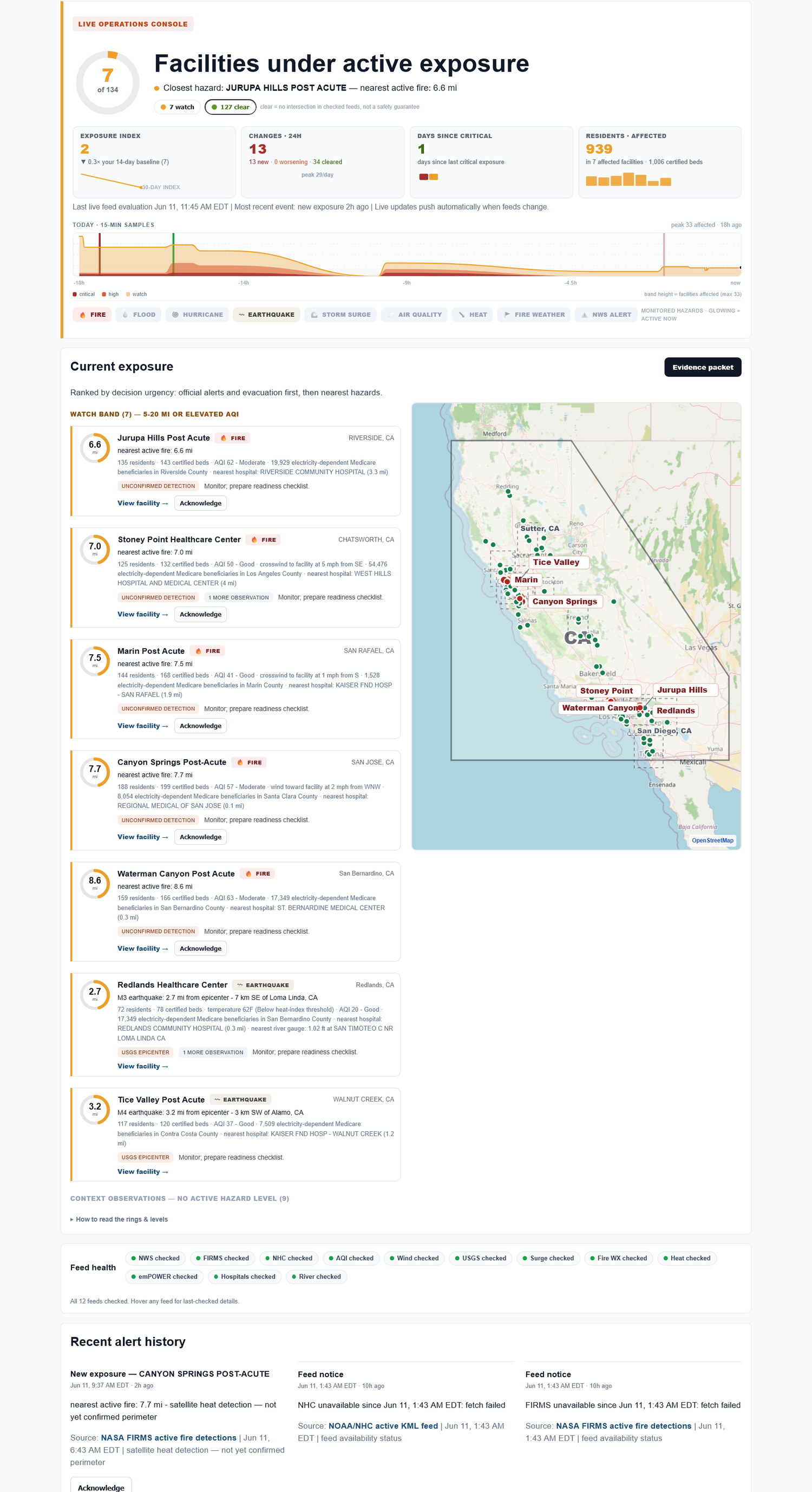
Smoke and air-quality monitoring for nursing homes should capture facility scope, observed air-quality concern, source, timing, status, and whether the concern cleared or persisted. Exposure Watch preserves that external record without collecting resident information.
Smoke exposure is not always dramatic. It may be a series of moderate days, one bad afternoon, or a nearby wildfire that changes the facility conversation.
Why smoke exposure disappears from the file
If nobody saves the record, the event can turn into a vague memory: the week the sky looked bad. That is not very useful for annual review or board questions.
A timestamped source trail gives the team a more precise way to review recurring smoke or air-quality pressure.
Smoke and air-quality evidence checklist
Use this short worksheet to capture what the team needs before the formal review, not as a substitute for the official program.
| Element | How to use it |
|---|---|
| Facility observation | Save the source-cited smoke or air-quality concern tied to the building. |
| Duration | Note first-seen and last-checked times so repeated exposure does not disappear. |
| Clinical boundary | Keep resident-care decisions in the facility record, not this external-hazard worksheet. |
Download worksheet This static worksheet is a practical review aid, not a certification or official filing tool.
How Exposure Watch helps
Exposure Watch preserves facility-level smoke and air-quality exposure rows with source, status, timing, and change history. It supports review and documentation without advising clinical interventions.
The evidence trail to keep on every page
| Facility | Hazard | Source | Status / distance | First seen | Last checked | Export |
|---|---|---|---|---|---|---|
| Facility A | Wildfire smoke | Authoritative, source-cited alert | Nearby / active | timestamp | timestamp | Export |
| Facility B | Power shutoff | Authoritative, source-cited notice | Possible impact | timestamp | timestamp | Export |
| Facility C | Flood | Authoritative, source-cited alert | Watch area | timestamp | timestamp | Export |
Built automatically from the same live checks - no extra binder work.
What Exposure Watch does not do
Exposure Watch does not replace your emergency-preparedness program, make compliance guarantees, file regulatory reports, run incident command, or tell staff what to do in the moment. It helps your team keep the facility-level external-hazard picture and evidence trail current.
FAQ
Does Exposure Watch provide clinical air-quality instructions?
No. It preserves external smoke and air-quality exposure history. Clinical guidance and resident-care decisions remain with your facility and medical leadership.
Why track moderate smoke days if no emergency occurred?
Repeated or nearby exposure can matter during annual review, board questions, and preparedness discussions even when no single day became a major incident.
Does Exposure Watch collect PHI?
No. Exposure Watch is facility-level external-hazard monitoring. Do not enter resident names, patient records, medical details, or clinical data.
Does Exposure Watch tell staff what to do during an incident?
No. It surfaces facility exposure and preserves the record. Your team keeps responsibility for operations, clinical judgment, reporting, and emergency-preparedness decisions.