
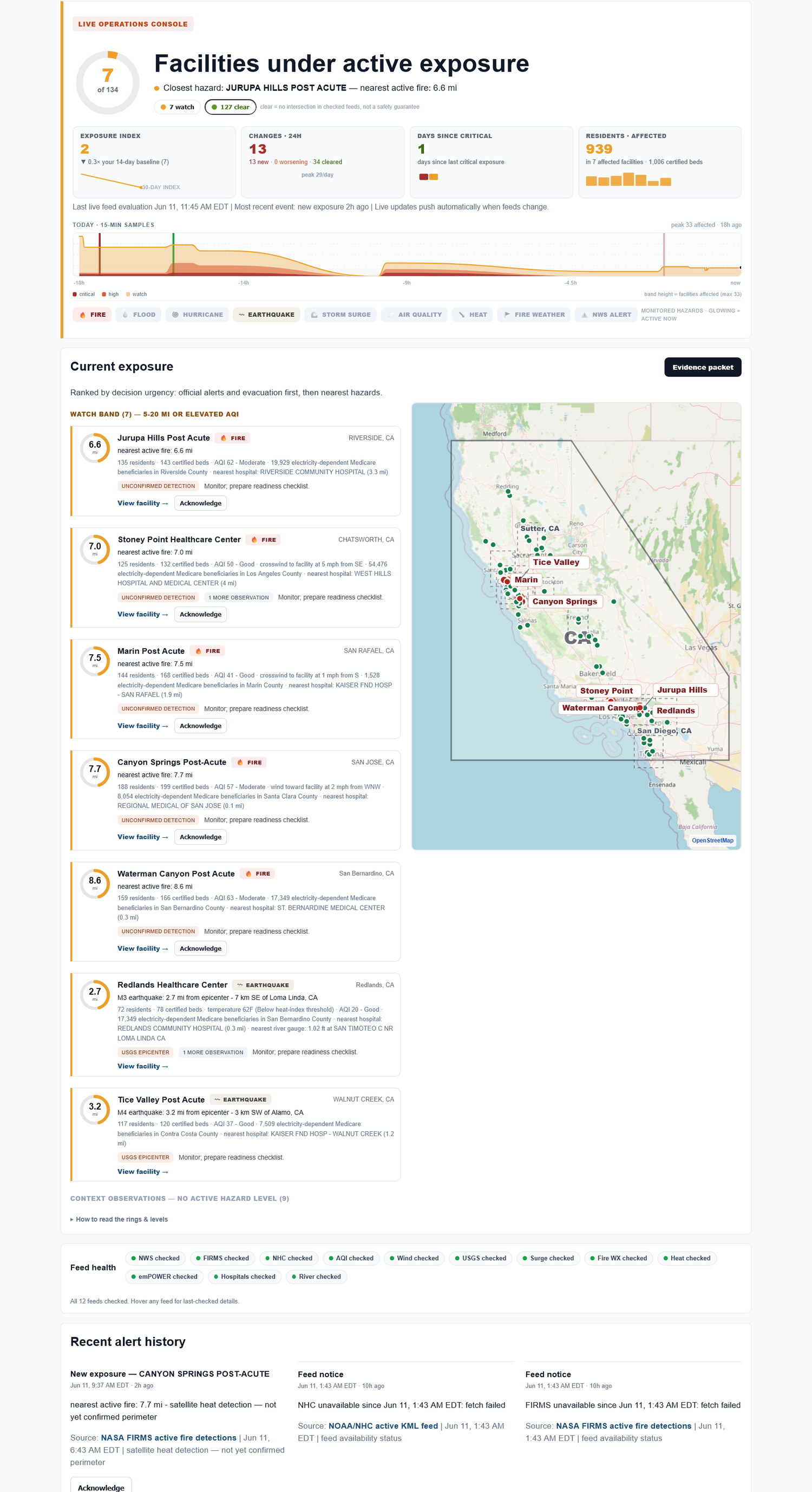
Fast answer
What should skilled nursing teams monitor during wildfire exposure?
Wildfire exposure monitoring should be facility-specific, not just county-level. The useful record shows the facility, fire or smoke concern, source, distance or status, first-seen time, last-checked time, and change history.
A map screenshot is a weak archive. It may show one moment, but it rarely shows when the exposure first appeared or when it cleared.
Why wildfire exposure is hard to summarize later
A fire can be headline-grabbing miles away while smoke or access issues matter closer to the building. Multi-facility teams need a way to sort urgency without guessing from memory.
The review later needs the facility-level trail, not just the fact that a wildfire happened somewhere in the region.
Wildfire exposure evidence checklist
Use this short worksheet to capture what the team needs before the formal review, not as a substitute for the official program.
| Element | How to use it |
|---|---|
| Facility distance or status | Save the source-cited proximity or active status. |
| Smoke or access concern | Flag related conditions that may matter to the facility review. |
| Clearance point | Save when the concern cleared or stopped changing. |
Download worksheet This static worksheet is a practical review aid, not a certification or official filing tool.
How Exposure Watch helps
Exposure Watch preserves wildfire-adjacent exposure rows for each monitored building, including source, status, distance where available, timing, and change history. It supports review; it does not make evacuation or staffing decisions.
The evidence trail to keep on every page
| Facility | Hazard | Source | Status / distance | First seen | Last checked | Export |
|---|---|---|---|---|---|---|
| Facility A | Wildfire smoke | Authoritative, source-cited alert | Nearby / active | timestamp | timestamp | Export |
| Facility B | Power shutoff | Authoritative, source-cited notice | Possible impact | timestamp | timestamp | Export |
| Facility C | Flood | Authoritative, source-cited alert | Watch area | timestamp | timestamp | Export |
Built automatically from the same live checks - no extra binder work.
What Exposure Watch does not do
Exposure Watch does not replace your emergency-preparedness program, make compliance guarantees, file regulatory reports, run incident command, or tell staff what to do in the moment. It helps your team keep the facility-level external-hazard picture and evidence trail current.
FAQ
Why is wildfire monitoring different for skilled nursing facilities?
Resident movement, staffing, transport, smoke, and power concerns make facility-level awareness more useful than a broad regional headline.
Does Exposure Watch tell a facility when to evacuate?
No. It provides external exposure awareness and a saved source trail. Evacuation decisions and instructions stay with the facility, authorities, and care team.
Does Exposure Watch collect PHI?
No. Exposure Watch is facility-level external-hazard monitoring. Do not enter resident names, patient records, medical details, or clinical data.
Does Exposure Watch tell staff what to do during an incident?
No. It surfaces facility exposure and preserves the record. Your team keeps responsibility for operations, clinical judgment, reporting, and emergency-preparedness decisions.